The EU-funded TRUSTING Project has reached a major new phase as participant recruitment officially begins across international study sites under Work Package 4 (WP4).
Ethical Approval Completed Across All TRUSTING Study Sites
A key milestone for the TRUSTING clinical study has been the successful completion of ethical approval at all participating research centres. This confirms that the study meets all ethical and regulatory requirements and enables the project to move forward with full study implementation.

International Participant Recruitment Now Underway
With approvals in place, participant recruitment has now started across multiple countries, marking the transition from preparation to active implementation. Researchers are enrolling participants according to the project timeline, allowing large-scale data collection to begin.
This next phase is essential for advancing TRUSTING’s goal of developing AI-driven and speech-based monitoring tools that support early identification of relapse risk in psychosis.

Study Registration to Ensure Public Transparency
The TRUSTING study has also been submitted for registration on ClinicalTrials.gov, where it is currently under review. Once approved, study details will be publicly accessible, ensuring transparency and allowing clinicians, researchers and the public to follow study progress.

Strong Coordination Across International Study Sites
These regulatory and operational achievements within Work Package 4 were coordinated by Lucia Bautista, Clinical Trial Manager, in collaboration with partners across Europe to ensure readiness and alignment across all study locations.
Scientific Dissemination Strengthens TRUSTING Impact
Alongside study implementation, the consortium continues to expand its scientific impact. A comprehensive manuscript describing the international multicentre observational TRUSTING study design and methods has been published as a preprint, led by researchers at the University of Zurich in collaboration with European project partners and representatives with lived experience.
The TRUSTING study has also been presented at leading scientific events, including:
- DGPPN Congress, Berlin
- Annual TRUSTING Meeting, Barcelona
- Burghölzli Psychiatry Meeting, Zurich


Further conference presentations are planned in the coming months.
Smartphone-Based Monitoring for Psychosis Research
A comprehensive overview of the study design and methods of the international multicenter observational TRUSTING study was provided in form of a manuscript that was submitted and published as a preprint. The paper was led by Roya Hüppi at the University of Zurich, in collaboration with partners at UiT The Arctic University of Norway; the University Medical Center Groningen, the Netherlands; the Royal College of Surgeons in Ireland (RCSI); the Geneva University Hospitals, Switzerland; the Dokuz Eylul University, Turkey; The National Institute of Mental Health, the Czech Republic; Universitat Pompeu Fabra – Barcelona, Spain; and representatives with lived experience from GAMIAN-Europe. The study was further presented at the DGPPN Congress in Berlin, the annual TRUSTING meeting in Barcelona, and the Burghölzli Psychiatry Meeting in Zurich and it will soon be part of the poster presentations at SIRS in Florence.
Link to the preprint: https://doi.org/10.1101/2025.11.14.25339774

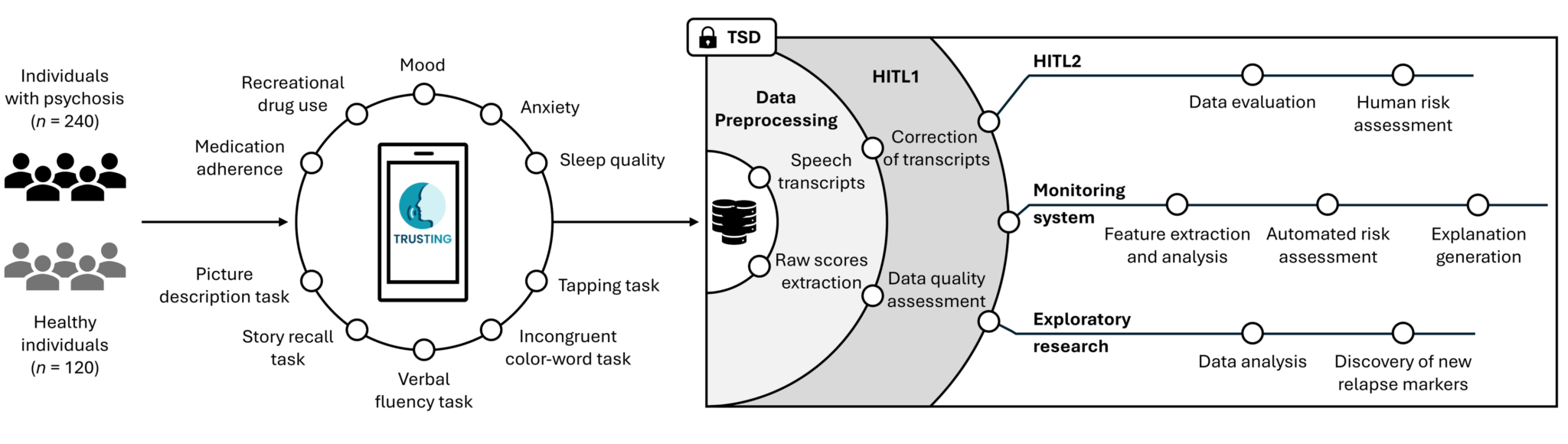
Overview of the study
The TRUSTING smartphone app will be used to collect weekly voice recordings through speech tasks (picture description, story recall, verbal fluency, and incongruent color-word task), self-reported information on medication adherence, recreational drug use, mood, anxiety, and sleep quality as well as motor data from a tapping task from individuals with psychosis and healthy individuals. All data will be transferred into a secure data storage (TSD), where they will be automatically preprocessed. Humans-in-the-loop 1 (HITL1) will correct transcripts and assess data quality. Humans-in-the-loop 2 (HITL2) will evaluate the data and assess relapse risk. The monitoring system will extract and analyze relevant features from the data and provide an automated risk assessment. Explanation generation is integrated into the system to make outputs interpretable for researchers. An exploratory research branch will focus on identifying new markers associated with relapse by analyzing features beyond those already established.
For more updates, insights, and news about TRUSTING’s progress, visit the TRUSTING Project website or follow us on social media:
Sign up for the yearly newsletter: shorturl.at/SvxFN
Funded by the European Union. Views and opinions expressed are, however, those of the author(s) only and do not necessarily reflect those of the European Union or of the European Health and Digital Executive Agency (HaDEA). Neither the European Union nor the granting authority can be held responsible for them.